IndiaBIX
IndiaBIX
Start typing & press "Enter" or "ESC" to close
  • Home
  • Jobs
  • Results
  • Current Affairs
  • GK
  • Online Test
  • HR Interview
  • BLOG

Interfacing to the Analog World - General Questions (5)

  • Home
  • Electronics & Communication Engineering
  • Digital Electronics Questions with Answers
  • Interfacing to the Analog World - General Questions
Directions to Solve

Interfacing to the Analog World - General Questions

33. 

A 4-bit stairstep-ramp A/D converter has a clock frequency of 100 kHz and maximum input voltage of 10 V.

A. The maximum number of samples per second will be 6250.
B. The maximum sample rate will be 100,000 samples/second.
C. The minimum sample rate will be 6250 samples/second.
D. The minimum sample rate will be 100,000 samples/second.

Answer: Option C

Explanation:

No answer description available for this question. Let us discuss.

View Answer Discuss Workspace Report

34. 

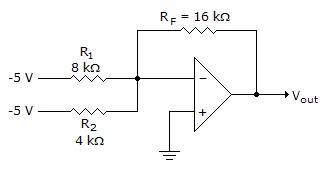
What is the current in R1 and the current in R2 for the circuit shown below?

mcq15_1005_1 (1)

A. I1 = 0.416 mA, I2 = 0.416 mA
B. I1 = 0.357 mA, I2 = 0.357 mA
C. I1 = 1.25 mA, I2 = 0.625 mA
D. I1 = 0.625 mA, I2 = 1.25 mA

Answer: Option D

Explanation:

No answer description available for this question. Let us discuss.

View Answer Discuss Workspace Report

35. 

Which of the following characterizes an analog quantity

A. Discrete levels represent changes in a quantity.
B. Its values follow a logarithmic curve.
C. It can be described with a finite number of steps.
D. It has a continuous set of values over a given range.

Answer: Option D

Explanation:

No answer description available for this question. Let us discuss.

View Answer Discuss Workspace Report

36. 

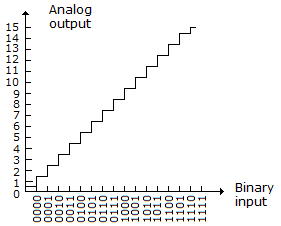
Referring to the given figure, what appears to be wrong, if anything, with the D/A converter and what should be done to correct the problem?

mcq11_1017_1

A. There is nothing wrong with the converter.
B. There is an offset error; if no provision is made for adjusting the offset, the op-amp may need to be changed.
C. There is a nonlinearity error; the op-amp must be changed.
D. The power supply voltage appears to be too high; adjust the power supply to the correct value.

Answer: Option B

Explanation:

No answer description available for this question. Let us discuss.

View Answer Discuss Workspace Report

37. 

The output of a basic 4-bit input digital-to-analog converter would be capable of outputting:

A. 16 different values of voltage or current that are not proportional to the input binary number
B. 16 different values of voltage or current that are proportional to the input binary number
C. 32 different values of voltage or current that are not proportional to the input binary number
D. 32 different values of voltage or current that are not proportional to the input binary number

Answer: Option B

Explanation:

No answer description available for this question. Let us discuss.

View Answer Discuss Workspace Report

38. 

Which of the statements below best describes the basic operation of a dual-slope A/D converter?

A. The input voltage is used to set the frequency of a voltage-controlled oscillator (VCO). The VCO quits changing frequency when the input voltage stabilizes. The frequency of the VCO, which is proportional to the analog input voltage, is measured and is displayed on the digital display as a voltage reading.
B. A ramp generator is used to enable a counter through a comparator. When the ramp voltage equals the input voltage, the counter is latched and then reset. The counter reading is proportional to the input voltage since the ramp is changing at a constant V/second rate.
C. A ramp voltage and analog input voltage are applied to a comparator. As the input voltage causes the integrating capacitor to charge, it will at some point equal the ramp voltage. The ramp voltage is measured and displayed on the digital panel meter.
D. Two ramps are generated: one by the input voltage and the other by a reference voltage. The input voltage ramp charges the integrating capacitor, while the reference voltage discharges the capacitor and enables the counter until the capacitor is discharged, at which time the counter value is loaded into the output latches.

Answer: Option D

Explanation:

No answer description available for this question. Let us discuss.

View Answer Discuss Workspace Report

39. 

When comparing the conversions from digital-to-analog and analog-to-digital, the A/D conversion is generally:

A. less complicated but more time consuming than the D/A conversion.
B. more complicated and more time consuming than the D/A conversion.
C. less complicated and less time consuming than the D/A conversion.
D. more complicated but less time consuming than the D/A conversion.

Answer: Option B

Explanation:

No answer description available for this question. Let us discuss.

View Answer Discuss Workspace Report

40. 

An analog-to-digital converter has a four-bit output. How many analog values can it represent?

A. 4
B. 1/4
C. 16
D. 0.0625

Answer: Option C

Explanation:

No answer description available for this question. Let us discuss.

View Answer Discuss Workspace Report

  • 1
  • 2
  • 3
  • 4
  • 5
  • 6
  • 7
  • 8

Questions & Answers

Aptitude Chemical Engineering Civil Engineering Computer Science & Engineering Current Affairs Data Interpretation Electrical & Electronics Engineering Electronics & Communication Engineering General Knowledge Logical Reasoning Mechanical Engineering Non Verbal Reasoning Verbal Ability Verbal Reasoning

Interviews

HR Interview

Jobs

Sarkari Jobs

Results

Rojgar ResultSarkari Result

Admission

Admission 2023

Admit Card

Admit Card 2023

Answer Key

Answer Key 2023
copyright
Privacy Policy
© 2026 IndiaBIX. All Rights Reserved.

Report