IndiaBIX
IndiaBIX
Start typing & press "Enter" or "ESC" to close
  • Home
  • Jobs
  • Results
  • Current Affairs
  • GK
  • Online Test
  • HR Interview
  • BLOG

Counters - General Questions (9)

  • Home
  • Electronics & Communication Engineering
  • Digital Electronics Questions with Answers
  • Counters - General Questions
Directions to Solve

Counters - General Questions

65. 

A MOD-12 and a MOD-10 counter are cascaded. Determine the output frequency if the input clock frequency is 60 MHz.

A. 500 kHz
B. 1,500 kHz
C. 6 MHz
D. 5 MHz

Answer: Option A

Explanation:

No answer description available for this question.

View Answer Discuss Workspace Report

66. 

When two counters are cascaded, the overall MOD number is equal to the ________ of their individual MOD numbers.

A. product
B. sum
C. log
D. reciprocal

Answer: Option A

Explanation:

No answer description available for this question

View Answer Discuss Workspace Report

67. 

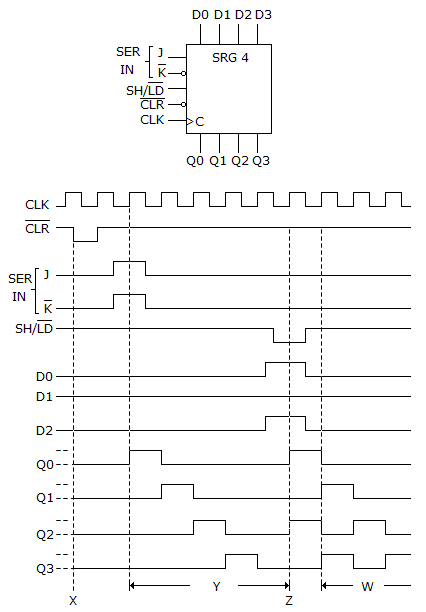
What type of register is shown below?

mcq7_1015_1

A. Parallel in/parallel out register
B. Serial in/parallel out register
C. Serial/parallel-in parallel-out register
D. Parallel-access shift register

Answer: Option D

Explanation:

No answer description available for this question

View Answer Discuss Workspace Report

68. 

What is the difference between a 7490 and a 7492?

A. 7490 is a MOD-12, 7492 is a MOD-10
B. 7490 is a MOD-12, 7492 is a MOD-16
C. 7490 is a MOD-16, 7492 is a MOD-10
D. 7490 is a MOD-10, 7492 is a MOD-12

Answer: Option D

Explanation:

No answer description available for this question.

View Answer Discuss Workspace Report

69. 

What is the difference between combinational logic and sequential logic?

A. Combinational circuits are not triggered by timing pulses, sequential circuits are triggered by timing pulses.
B. Combinational and sequential circuits are both triggered by timing pulses.
C. Neither circuit is triggered by timing pulses.

Answer: Option A

Explanation:

No answer description available for this question

View Answer Discuss Workspace Report

70. 

Synchronous counters eliminate the delay problems encountered with asynchronous counters because the:

A. input clock pulses are applied only to the first and last stages
B. input clock pulses are applied only to the last stage
C. input clock pulses are not used to activate any of the counter stages
D. input clock pulses are applied simultaneously to each stage

Answer: Option D

Explanation:

No answer description available for this question. 

View Answer Discuss Workspace Report

71. 

Synchronous construction reduces the delay time of a counter to the delay of:

A. all flip-flops and gates
B. all flip-flops and gates after a 3 count
C. a single gate
D. a single flip-flop and a gate

Answer: Option D

Explanation:

No answer description available for this question

View Answer Discuss Workspace Report

72. 

Integrated-circuit counter chips are used in numerous applications including:

A. timing operations, counting operations, sequencing, and frequency multiplication
B. timing operations, counting operations, sequencing, and frequency division
C. timing operations, decoding operations, sequencing, and frequency multiplication
D. data generation, counting operations, sequencing, and frequency multiplication

Answer: Option B

Explanation:

No answer description available for this question

View Answer Discuss Workspace Report

  • 1
  • 2
  • 3
  • ..
  • ..
  • 8
  • 9
  • 10

Questions & Answers

Aptitude Chemical Engineering Civil Engineering Computer Science & Engineering Current Affairs Data Interpretation Electrical & Electronics Engineering Electronics & Communication Engineering General Knowledge Logical Reasoning Mechanical Engineering Non Verbal Reasoning Verbal Ability Verbal Reasoning

Interviews

HR Interview

Jobs

Sarkari Jobs

Results

Rojgar ResultSarkari Result

Admission

Admission 2023

Admit Card

Admit Card 2023

Answer Key

Answer Key 2023
copyright
Privacy Policy
© 2026 IndiaBIX. All Rights Reserved.

Report